Every earlier reason to fix item data was internal. A declaration to an authority is not, and it reads the same fields procurement has been missing for years.
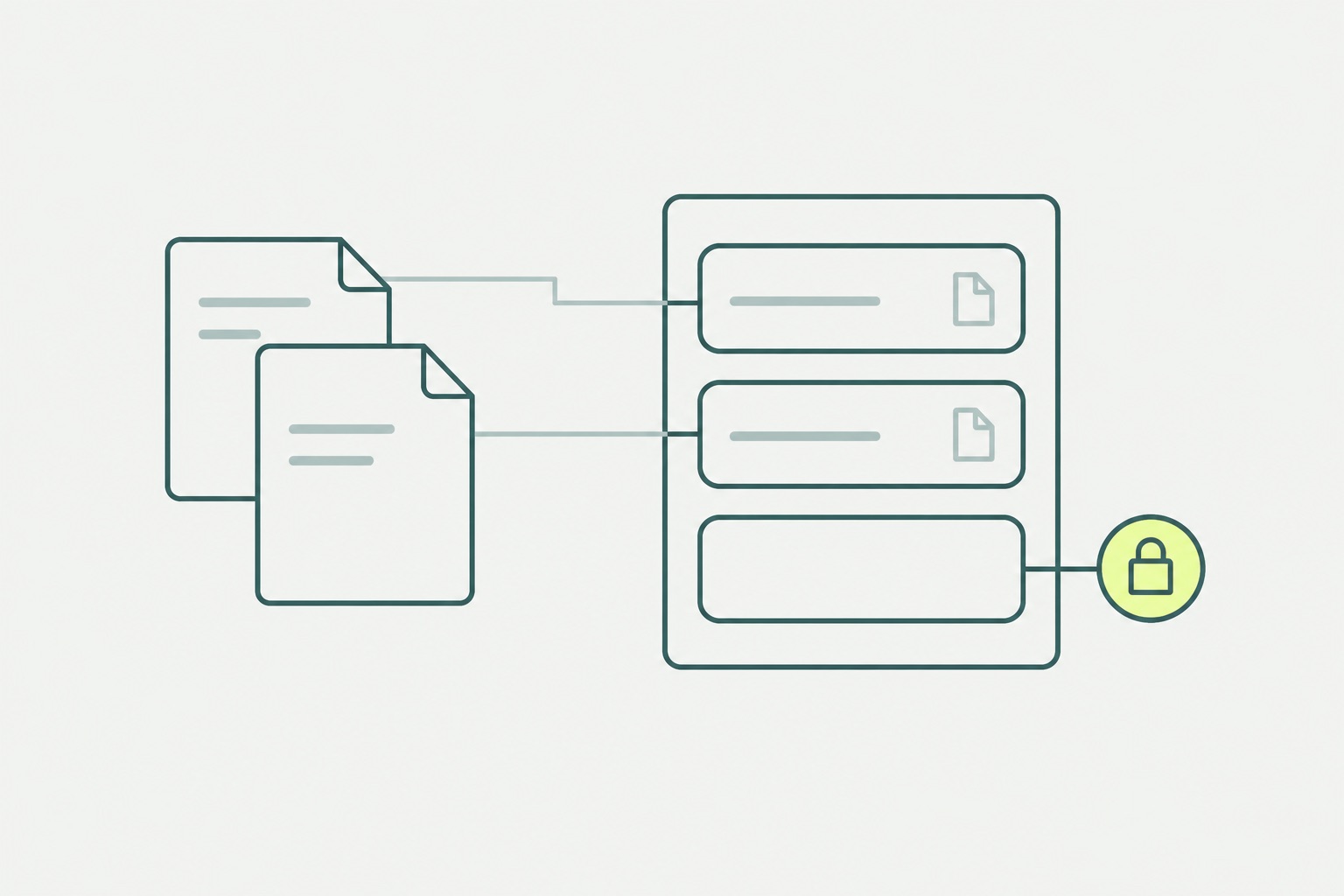
A company that buys steel brackets through a distributor usually has a record something like this one:
That record has been good enough for a long time. It is not good enough to answer a question an authority asks in writing.
If the distributor imports the brackets, the carbon border declaration is the distributor’s. The question still comes back down the chain, as a customer’s Scope 3 request, a carbon footprint in a tender or a field in a product passport, and it asks for the same fields either way.
Scope follows the code, not the product
The de minimis threshold for the EU carbon border adjustment mechanism is set in cumulative net mass. An importer staying under fifty tonnes a year of the covered goods, iron and steel, aluminium, fertilisers and cement, has no CBAM obligations, as long as it can show that it stays under. Below the line, nothing is owed.
That sounds like relief for a smaller importer, and it is. But only for one that can show it.
The threshold is net mass, across specific CN codes, summed over a calendar year, and crossing it at any point brings the whole year’s imports into scope. A register that carries neither a reliable net mass nor a reliable CN code cannot produce that sum. It cannot demonstrate that the company is below the line, and it cannot warn that the company is about to cross it.
An exemption that cannot be measured is not an exemption. It is a hope with a deadline.
Scope also does not follow the product category. The covered goods are listed by customs code, which means a manufacturer can be in scope for a material it buys and out of scope for the product it makes from that material. The question “does this apply to us” therefore has no company-level answer at all. It is a per-item question, and it is answered with two fields.
An assumption becomes an assertion
Inside a company, a guessed field is an irritation. A zero net weight slows a freight quote. An inherited customs code is discovered during an audit, or is not discovered.
In a declaration, the same field is a statement to a government, kept on file.
Country of origin is the clearest case of the shift. In electronics, origin is a property of the production batch rather than of the part number: the same component can be manufactured in several plants in several countries, and which one is in the box depends on the shipment. A register carrying one origin per item is carrying an assumption formatted as data.
Some companies that understand this cope by assuming the least favourable origin for duty purposes. That is honest, and it is expensive. Companies that do not understand it report a figure they cannot support.
Neither case is improved by better reporting software. Both are improved one field at a time, with a source attached.
Three kinds of missing, and only two are document problems
Ask for the evidence behind a sustainability figure and the gaps turn out not to be alike. They need different actions, and sorting them is most of the work.
Published, hard to reach
The figure exists in a datasheet or a certificate, but the document sits behind a login, or is not indexed, or belongs to a distributor rather than the manufacturer. For a purchased part the figure is often in the company’s own paperwork as well, on a delivery note, an invoice or an import declaration, but for the shipment and its packaging rather than for one unit, and filed with receiving or finance instead of with the item. This is a retrieval problem, it is solvable, and it is where most of the volume sits.
Published by someone other than the maker
Recycled content of a purchased material is the common example: manufacturers rarely state it, and suppliers issue certificates that do. Country of origin frequently appears on a reseller’s page and not in the maker’s own datasheet. Solvable, but not where anyone looks first.
Never written down by anyone
Some figures are not properties of a part. How much recycled material a plant actually consumed last quarter, which batch ended up in which box, the energy a particular process drew: those are events, and events live in meters, invoices and batch records. No amount of document reading will produce them.
The third kind matters because it is the one a supplier is tempted to promise. Knowing which of the missing fields fall into it is worth more than another month of searching, because it sends the work to where the data actually is instead of to where it is not.
The same fields, a new reader
Net mass. Material and composition. Country of origin. Customs classification. Intended use. Those are the fields a carbon border declaration rests on, and they are the fields every earlier reader of the record already needed:
- Customs
A classification that rests on material and intended use.
- Aftermarket
A spare-part quotation that needs weight and dimensions.
- Logistics
A freight rate quoted on net mass.
- Carbon border
A declaration summed in net mass across customs codes.
- Product passport
Material, composition and origin, as each product group gets its rules.
- Procurement
The same part recognised under every code it has.
The battery passport already has a date. Sustainability reporting did not create a new data requirement. It added a new reader for one that was already failing: a reader that asks in writing, keeps the answer, and is entitled to come back.
Which makes the business case simpler than it first appears. This is not a sustainability project. It is the item master project that was already overdue, now with a date attached.
- The carbon border de minimis is measured in net mass across customs codes, so a company cannot establish that it falls below the threshold without both fields at item level.
- Scope follows the customs code rather than the product category: a purchased input can be in scope while the finished product is not.
- In electronics, country of origin is a property of the batch. One origin per item is an assumption, and in a declaration an assumption becomes an assertion.
- Missing data splits three ways: hard to reach, published by a third party, or never written down. Only the first two can be solved by reading documents.
- The fields sustainability reporting reads are the fields procurement, customs and after-sales already needed.
Sources
- Regulation (EU) 2025/2083 amending the CBAM Regulation, EUR-Lex
- Regulation (EU) 2023/1542 concerning batteries and waste batteries, EUR-Lex
Further reading

More than 20 years turning data and AI into business value and working solutions. CEO of Data Design, previously at Silo AI. At inRecipe he leads the product and the Starts.