Ask anyone who has tried to enrich an item master where the time goes, and they will tell you about the search. Finding the maker. Finding the right document on the maker’s site. Finding the page. Finding the row on the page that is actually this part and not its neighbour.
Transcript
Take a bolt. ISO 4017, M24, 175 millimetres, grade 8.8. That line is not a description. It is a complete specification. The standard says exactly how wide the head is, how long the thread is, what the steel weighs.
So why would anyone search the internet for the weight of that bolt?
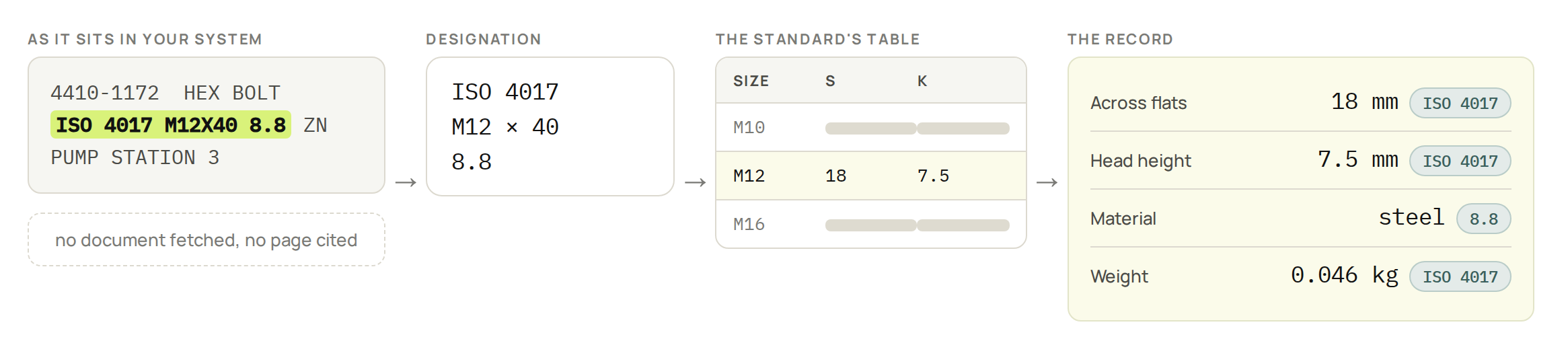
inRecipe reads the designation, opens the standard’s own dimension table, and computes the weight. Then it names the part the way the standard names it, and it places it under the right customs heading. No search, no guessing, no waiting: the answer is exact, and it is the same every time.
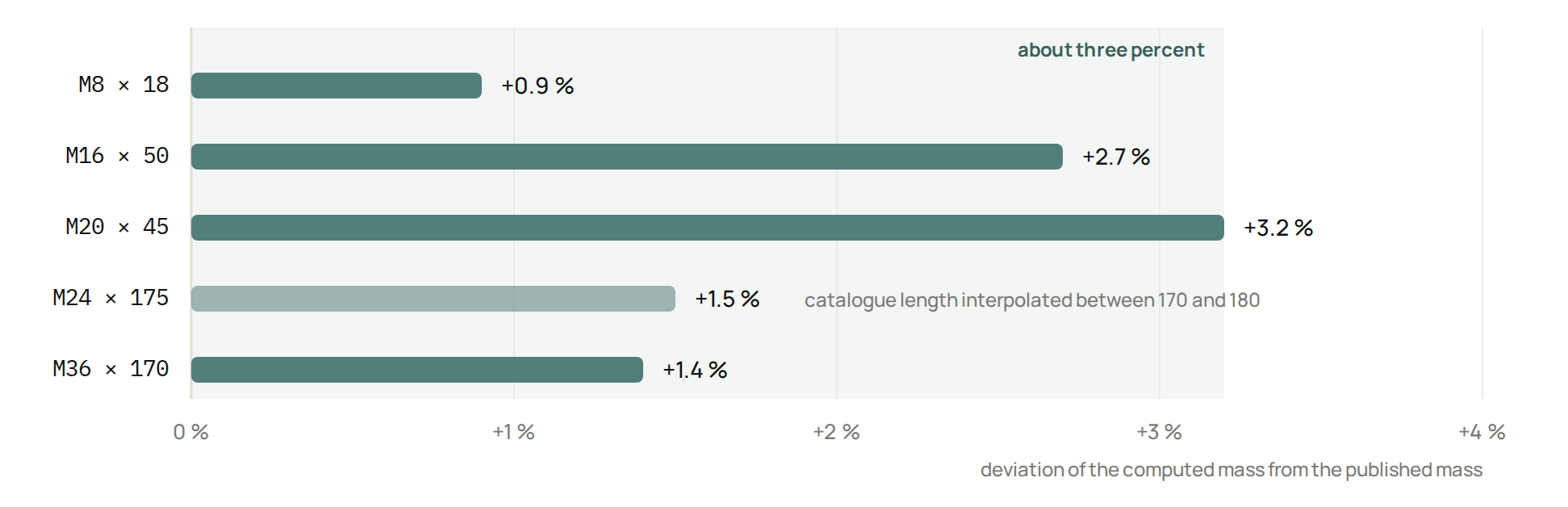
In a recent start, about a third of the customer’s sample were parts like this: bolts, nuts, washers, pins, belts. Every one of them resolved from the standard itself, and the computed weights came within three percent of a published weight table.
That leaves the research effort for the parts that actually need it: the pump, the sensor, the bearing with a maker’s catalogue behind it.
Standard parts first. They are exact, and they are done in seconds.
For a pump or a contactor there is no way around that work: the truth about the part lives in the maker’s own documents, and the only honest value is one that points at a page.
Then you reach the bolts.

The standard is the specification
A hex bolt described as ISO 4017 M12 x 40 8.8 has no manufacturer, and it does not need one. The standard is the specification. ISO 4017 says what an M12 hex bolt is: the width across flats, the head height, the thread. The property class, 8.8, says what it is made of and how strong it must be. The length is in the designation. There is nothing left to find. Every bolt made to that standard, by any maker, in any country, has those dimensions, or it is not an ISO 4017 bolt.
Nothing is searched
That changes what enrichment means for these items. Nothing is searched. No document is fetched, no page is cited, no maker is guessed at. The designation is lifted out of the description, the dimensions are taken from the standard’s own table for that size, the material follows from the property class, and the mass follows from the geometry and the density of the material. The record ends up with a name, a sales text, dimensions, a material and a weight, and every one of those values carries the standard it was computed from rather than a page it was read from.
How good is a computed weight?
Good enough to ship. On a recent sample we checked the computed masses of five sizes against the figures in a distributor’s catalogue, and they landed within about three percent. The difference is the difference between an idealised geometry and a real head with a chamfer; it is small, it is explainable, and it is the same in every direction, which is more than can be said for a weight someone typed in from memory.
Why this is good news
Standard parts are rarely a small group: bolts, screws, nuts, washers, pins, set screws, the occasional belt. They are the part of the master that can be completed entirely from public standards, without a single search, with no dependence on a maker who may have moved the datasheet or stopped publishing it. They are also the part where a wrong value is hardest to excuse, because the right one was never hidden.
Two honest limits
The tables have to exist in the library for each standard, and they do not all exist yet; a standard without a table gets a name and a sales text today and its dimensions when the table is added. And a few standard parts need a maker after all: a lifting eye nut’s load rating is the maker’s statement, not the standard’s. The item is sorted on day one, so you know which group each of your bolts falls into before anything is computed.
Sort the master first. The part with no manufacturer is the easy part, and it is a good place to start seeing what a record with evidence looks like.
- A standard part has no manufacturer: the standard is the specification.
- Its dimensions, material and weight are computed from the standard, not searched, and each value carries the standard it came from.
- Computed weights landed within about three percent of a distributor’s catalogue on a recent sample.
- Sort the item master first; the standard parts are the easy place to start.
Further reading

More than 20 years turning data and AI into business value and working solutions. CEO of Data Design, previously at Silo AI. At inRecipe he leads the product and the Starts.